
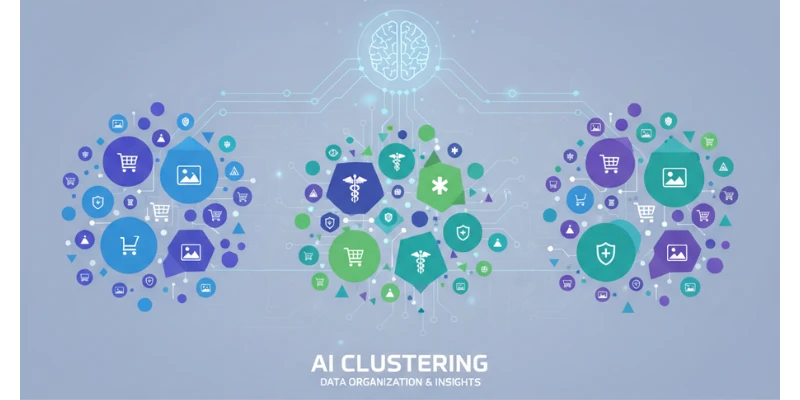
Artificial Intelligence (AI) is built on the idea of making machines learn from data. One powerful way AI does this is through a technique called clustering. Clustering helps AI find patterns and group similar data points without any human instruction. It plays a key role in making sense of large amounts of data. If you’re interested in learning how these concepts work in real-world scenarios, enrolling in an Artificial Intelligence Course in Trivandrum at FITA Academy can be a great place to start. Their training programs are designed to help beginners understand how AI techniques like clustering are applied across various industries.
Let’s break down what clustering is and how it helps AI make better decisions.
Understanding Clustering
Clustering is a type of unsupervised learning, which means the AI is not given labeled data. Instead, it is simply fed raw information and asked to find structure or patterns within it. The goal is to group data points that are similar to each other into clusters, or groups.
Imagine you are given a box full of different colored beads. You don’t know how many types of colors are in there, but you start grouping them based on how similar they look. That’s exactly what clustering does. It organizes data into meaningful categories without being told what those categories should be. If you want to explore these concepts further through hands-on learning, enrolling in an Artificial Intelligence Course in Kochi can provide practical insights and real-world applications of AI techniques like clustering.
Why Clustering Matters
Clustering is widely used in AI because it helps discover hidden patterns. It is especially useful when dealing with huge datasets where manual sorting is impossible.
For example:
- In marketing, companies use clustering to group customers based on shopping behavior.
- In healthcare, clustering can help detect patterns in patient data, leading to better diagnosis.
- In image recognition, AI can group images based on visual similarities.
- In cybersecurity, clustering helps detect unusual activity or potential threats by grouping normal and abnormal behavior.
These real-world applications show how valuable clustering can be when there is no predefined structure in the data.
How AI Groups Similar Things
AI uses mathematical methods to measure how similar or different data points are. These measures help the algorithm decide which items belong together. Data points that are close to each other in terms of features are placed in the same cluster.
Think of it like placing similar fruits in a basket. Apples go in one basket, oranges in another, and bananas in a third. The AI looks at features like size, color, or shape to make these groupings. It works much like how we do it in daily life. In order to obtain a more profound insight into the decision-making processes of AI, you can consider joining an Artificial Intelligence Course in Pune, where practical training helps you apply these concepts with real datasets.
Types of Clustering
There are different types of clustering methods, each suited for different situations. Some common ones include:
- Partitioning clustering: This creates distinct clusters where each data point belongs to only one group.
- Hierarchical clustering: This builds a tree-like structure of clusters, where smaller groups are nested within larger ones.
- Density-based clustering: This finds clusters based on how closely packed the data points are.
Every method possesses its advantages, and the selection is based on the data type and the issue that needs to be addressed.
Clustering is an essential concept in AI that helps uncover patterns hidden in data. By grouping similar items together, AI can analyze complex information in a meaningful way. It is a key step in making data-driven decisions, powering everything from recommendations to fraud detection. If you’re looking to build a strong foundation in these techniques, exploring AI Courses in Jaipur can be a great way to start your journey into the world of artificial intelligence.
Understanding clustering gives you a better sense of how AI “thinks” and makes sense of the world around us.
Also check: Recurrent Neural Networks That Power AI Sequence Learning